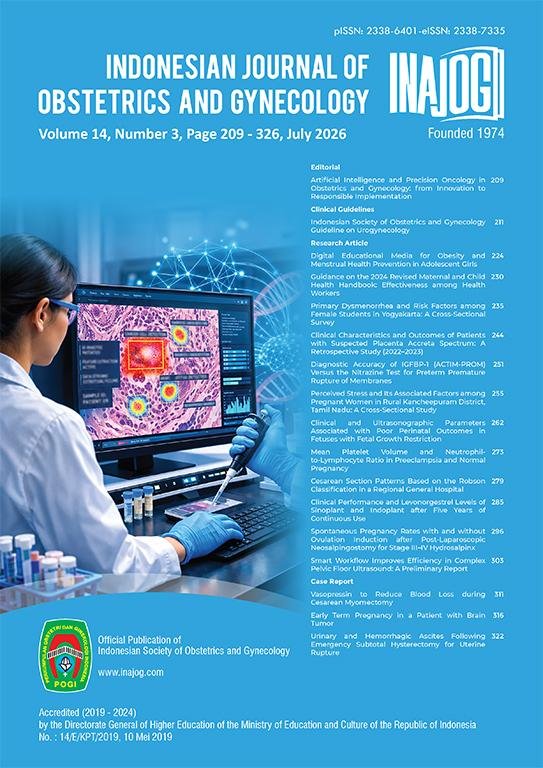
Artificial Intelligence and Precision Oncology in Obstetrics and Gynecology: from Innovation to Responsible Implementation
DOI:
https://doi.org/10.32771/inajog.v14i3.3414Abstract
Artificial intelligence (AI) and precision oncology are increasingly converging in obstetrics and gynecology, offering new opportunities for the management of cervical, endometrial, ovarian, vulvar, and rare uterine malignancies. AI enables recognition of complex patterns across clinical records, imaging, cytology, histopathology, and genomic data, while precision oncology translates these insights into individualized prevention, diagnosis, and treatment. Advances in image‑based applications, such as cervical cytology interpretation, tumor segmentation, and radiomics, illustrate the potential of AI to improve consistency and throughput. Meanwhile, molecular classification has reshaped endometrial cancer staging and management, with biomarker‑informed therapies demonstrating tangible clinical benefits.
Responsible implementation remains essential to ensure transparency, validation, and equity. Algorithms must be prospectively tested, externally validated, and aligned with contemporary guidelines, patient preferences, and resource contexts. For Indonesia, the editorial emphasizes building locally validated systems, multicenter datasets, tiered molecular testing, and clinician training in data literacy and ethical governance. The ultimate goal is not merely adopting sophisticated algorithms but establishing a learning health system where technology enhances clinical judgment, enabling earlier, more accurate, and more equitable gynecologic cancer care.
Downloads
Downloads
Published
How to Cite
Issue
Section
License
Copyright (c) 2026 Indonesian Journal of Obstetrics and Gynecology

This work is licensed under a Creative Commons Attribution-NonCommercial-ShareAlike 4.0 International License.