
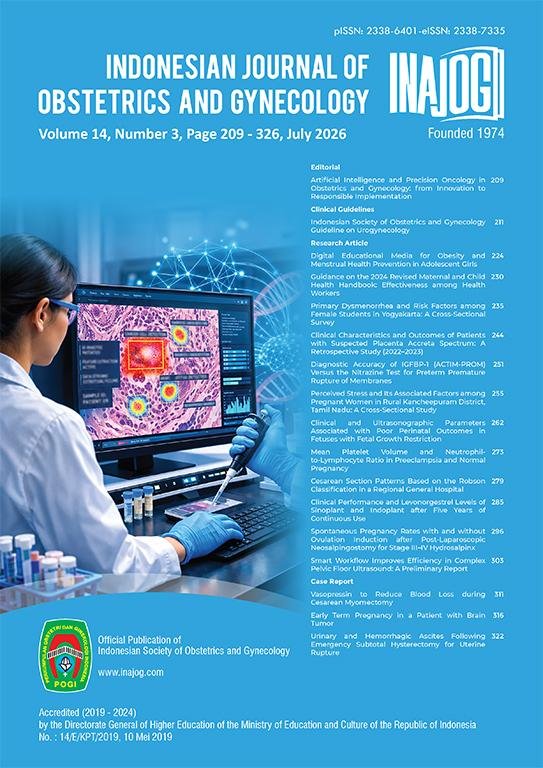
Clinical and Ultrasonographic Parameters Associated with Poor Perinatal Outcomes in Fetuses with Fetal Growth Restriction
DOI:
https://doi.org/10.32771/inajog.v14i3.3128Abstract
Objectives: to investigate the association between various clinical and ultrasonographic parameters and perinatal outcomes in cases of FGR, thereby enabling the assessment of FGR severity during the prenatal period and providing prognostic information regarding perinatal outcomes.
Method: This retrospective cohort study was conducted at Dr. Cipto Mangunkusumo General Hospital (RSCM), a tertiary referral hospital in Indonesia. Retrospective data were collected from January 2021 to December 2024 through medical record review. The study population consisted of pregnant women diagnosed with FGR, with a minimum gestational age of 28 weeks at delivery, who met the inclusion and exclusion criteria. Independent variables included a range of clinical and ultrasonographic parameters, while the dependent variable was adverse perinatal outcomes.
Results: Four hundred and eight pregnant women diagnosed with FGR were included in the study. Of these, 224 cases resulted in adverse perinatal outcomes. Multivariate analysis identified several factors significantly associated with adverse outcomes. These included preeclampsia with severe features [OR 1.83; 95% CI: 1.05–3.19], estimated fetal weight (EFW) below the 3rd percentile [OR 2.50; 95% CI: 1.40–4.46], absent or reversed end-diastolic flow (AREDF) in the umbilical artery [OR 11.93; 95% CI: 2.62–54.30], abnormal cerebroplacental ratio (CPR) [OR 1.87; 95% CI: 1.06–3.28], oligohydramnios [OR 1.81; 95% CI: 1.05–3.12], gestational age at delivery between 28 and <32 weeks [OR 69.54; 95% CI: 18.46–261.94], and gestational age between 32 and <37 weeks [OR 3.53; 95% CI: 1.92–6.49].
Conclusion: Several clinical and ultrasonographic parameters in FGR cases – which are preeclampsia with severe features, estimated fetal weight below the 3rd percentile, AREDF in umbilical artery, abnormal CPR, oligohydramnios and gestational age at delivery – showed a significant association with poor perinatal outcomes.
Keywords: fetal growth restriction; perinatal outcomes; ultrasonography.
Downloads
Published
Versions
- 2026-07-27 (1)
- 2026-07-27 (1)
How to Cite
Issue
Section
License
Copyright (c) 2026 Indonesian Journal of Obstetrics and Gynecology

This work is licensed under a Creative Commons Attribution-NonCommercial-ShareAlike 4.0 International License.