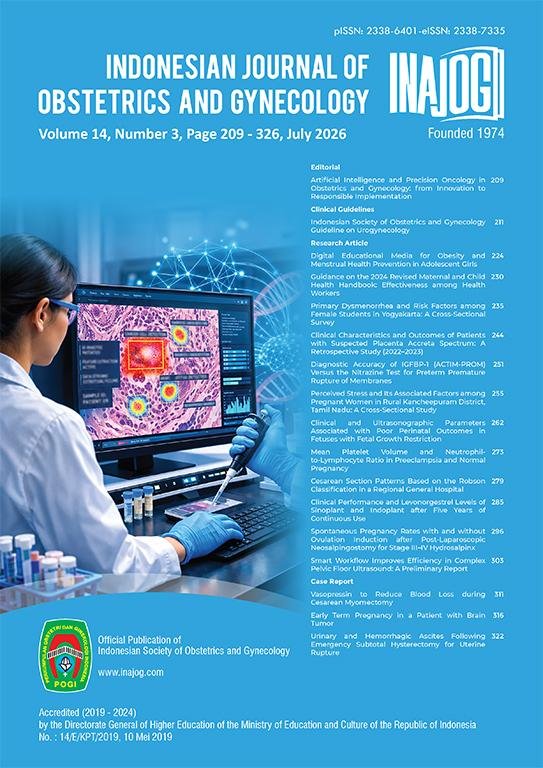
Spontaneous Pregnancy Rates with and without Ovulation Induction after Post-Laparoscopic Neosalpingostomy for Stage III–IV Hydrosalpinx
DOI:
https://doi.org/10.32771/inajog.v14i3.1726Abstract
Objective: To compare pregnancy outcomes between natural conception and ovulation induction following laparoscopic neosalpingostomy in women with stage III–IV hydrosalpinx.
Methods: A quasi-experimental study was conducted between 2014 and 2019 involving 70 infertile women who underwent laparoscopic neosalpingostomy. Participants were assigned to either a natural conception group or an ovulation induction group receiving clomiphene citrate and estradiol valerate. Patients were followed for six to seven months postoperatively. Pregnancy outcomes were analyzed using the chi-square test and multivariate logistic regression, with statistical significance set at p < 0.05.
Results: The overall pregnancy rate was 83% within seven months after surgery. Forty-one pregnancies occurred in the natural conception group. No significant association was found between ovulation induction or maternal age >35 years and term pregnancy (p > 0.05). Ectopic pregnancy occurred in 4–5% of cases. Multivariate logistic regression analysis identified no independent predictors of term pregnancy.
Conclusion: Laparoscopic neosalpingostomy remains a viable fertility-preserving treatment option for women with advanced hydrosalpinx. Pregnancy outcomes were comparable between women who conceived naturally and those who received ovulation induction therapy.
Keywords: hydrosalpinx, laparoscopic neosalpingostomy, pregnancy outcomes, spontaneous pregnancy
Downloads
Downloads
Published
How to Cite
Issue
Section
License
Copyright (c) 2026 Indonesian Journal of Obstetrics and Gynecology

This work is licensed under a Creative Commons Attribution-NonCommercial-ShareAlike 4.0 International License.